Fingal's Cave in 3D: Staffa's Basalt Sea Cave Before the Boat Lands
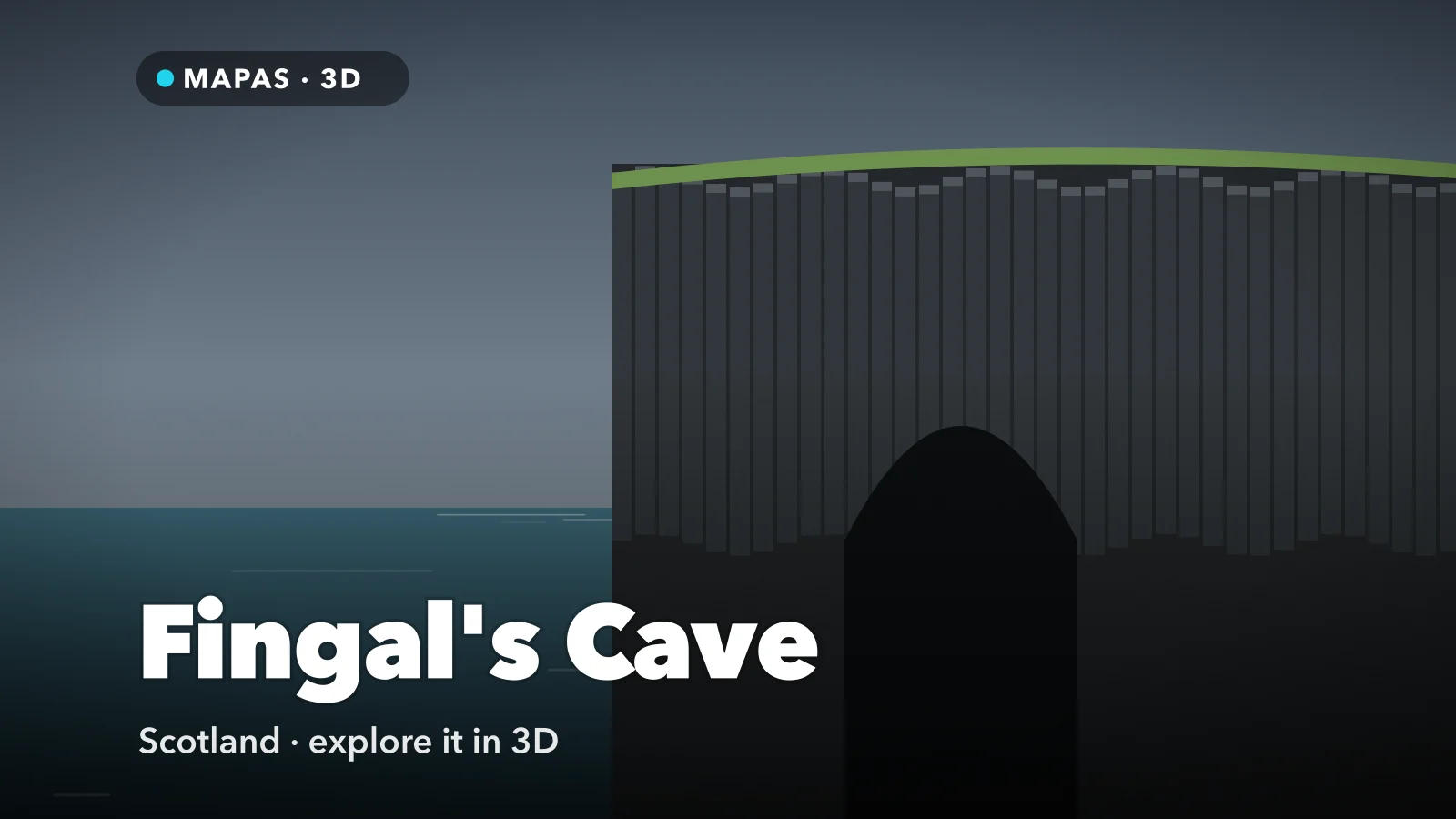
A sea cave framed by black basalt columns on Staffa, an uninhabited island in Scotland's Inner Hebrides that you can only reach by boat. Here is how to explore Fingal's Cave in 3D from your iPhone, and why the island's layered cliffs are worth reading before you land.
Fingal's Cave is cut into the southern end of Staffa, a small uninhabited island in the Inner Hebrides, west of the Isle of Mull. From the water it looks less like a cave than a doorway: a tall arch framed by black basalt columns, with the sea running straight in and booming against the back wall.
Staffa has a landing stage, a stair and a path along the column tops, and nothing else built for visitors. You arrive by boat, usually get around an hour ashore if the swell allows a landing at all, and then you leave. That short window is why it pays to know the island before the engine cuts out.
You can study Staffa in 3D today, from your iPhone, and step onto the boat already knowing which way to turn.
What makes Fingal's Cave special
Around sixty million years ago, lava flooded across what is now western Scotland and northern Ireland. Where a thick flow cooled slowly and evenly, it shrank and cracked into columns, many of them six sided. Staffa is a block of that rock, and the cave is where the sea has broken into it. The same volcanism built the Giant's Causeway in County Antrim, which is why legend has Finn McCool building a road between the two.
In Gaelic the cave is An Uamh Bhinn, the melodious cave, after the echo of the waves inside. After Sir Joseph Banks visited in 1772 and described it, it became known as Fingal's Cave, named for the hero of James Macpherson's Ossian poems, drawn from that same Finn. Felix Mendelssohn visited in 1829 and the trip produced The Hebrides overture, still often called Fingal's Cave. The National Trust for Scotland now cares for the island, and in summer its clifftops belong to puffins.
How to explore Fingal's Cave in 3D
MAPAS shows Staffa and the sea around it in 3D. Be clear about the limit: the 3D view shows the island's shape and where the cave mouth sits at the southern tip, not the arch in detail or the chamber inside. That is what the boat is for.
For a first run, try this order:
- Search for Staffa, Scotland, switch to 3D and pull back until Mull, Iona and the Treshnish Isles share the frame.
- Orbit Staffa once at low height, watching where the cliffs stand sheer and where the shore drops to low rocky shelves.
- Tilt low from the sea off the southern end and face the cliff to see where Fingal's Cave opens at the island's southern tip.
- Move round to the landing by Clamshell Cave and follow the shoreline south to the cave mouth, the line the cliff-foot path takes.
- Rise over the grassy cap where the puffins nest and note how close the edge comes to the path.
- Drop into Street View on Mull at Fionnphort or Ulva Ferry, where many boats leave, and check the pier. Panoramas can be years old, so read the date.
Follow along in MAPAS
Free on the App Store for iPhone and iPad.
Beyond the cave
- Clamshell Cave — beside the landing, where the columns bend like the ribs of a hull.
- Am Buachaille — "the herdsman", a small cone of columns just offshore, passed on the walk from the landing to the cave.
- Boat Cave and MacKinnon's Cave — two more sea caves along the cliffs, best seen from the water.
- Iona — the island to the south, with its abbey, often paired with Staffa in one day.
- The Treshnish Isles — small islands to the north-west, where Lunga holds another puffin colony.
The sea decides whether you land
Boats only come alongside Staffa when the swell allows; on rough days they circle the island or stay in harbour. The path to the cave runs over wet, uneven column tops just above the water, with a handrail on the cliff side and open sea on the other. If waves are washing across it, do not go on.
Why Staffa is built in three layers
Flat on a map, Staffa is a green lozenge in the sea. Tilt the camera at its cliffs and you see how sheer they stand; from the boat you see what they are: a cross-section through a lava flow, stacked in three bands.
At the bottom sits tuff, compacted volcanic ash. Above it stands the colonnade, the straight pillars framing the cave mouth, where the flow cooled slowly and its cracks grew evenly. On top lies the entablature, a tangled band of thin, twisted columns where the upper surface cooled faster and less evenly, probably because water ran across it. Columns grow at right angles to the cooling surface, so where it curved they curved too, which is how Clamshell Cave got its bent ribs.
The swell drives into the vertical joints between columns, pulling out pillar after pillar. The tangled entablature has no clean joints to exploit, so it holds as a roof while the columns beneath are removed, leaving an arch roughly twenty metres high that runs some seventy metres into the island. Columns of the same kind turn up in Iceland, at Svartifoss and Reynisfjara.
Before you go
No permit is needed. Operators sail from Fionnphort, Ulva Ferry and Tobermory on Mull, from Iona, and on day tours from Oban that cross to Mull by ferry. The season runs roughly from spring to October, and every sailing depends on the weather, so keep a spare day in hand.
There are no toilets, shelter or café on the island. Bring waterproofs and layers even in summer, and boots with grip, because the steps from the landing are steep and wet columns are slick. Puffins often sit close to the path; give them room and keep off the burrows and the cliff edge.
Common questions
Where is Fingal's Cave?
On Staffa, an uninhabited island in the Inner Hebrides, off the west coast of Mull in Argyll and Bute, Scotland.
Can you walk inside Fingal's Cave?
On a calm day, yes. A path with a handrail leads from the landing along the foot of the cliff and some way inside. In a heavy swell it is dangerous, and the crew may keep you out.
When can you see puffins on Staffa?
Roughly from late April into early August, when they come ashore to breed. The rest of the year they are at sea.
Is MAPAS free to use?
Yes. It is free on the App Store to download and use, with limits. Premium removes the limits on live cameras, Street View and 3D, and the ads.
No crossing, no swell, no skipper calling off the landing. Just a pillar island and the cave linked to Mendelssohn's Hebrides overture, laid out in three dimensions to study at your own pace.
Open MAPAS, tilt the camera at the southern cliff of Staffa, and find the cave mouth before the boat does.
Explore Fingal's Cave in 3D
Open MAPAS on your iPhone and circle Staffa in 3D, from the southern cliff where Fingal's Cave opens to the landing by Clamshell Cave.
Download on theApp Store